
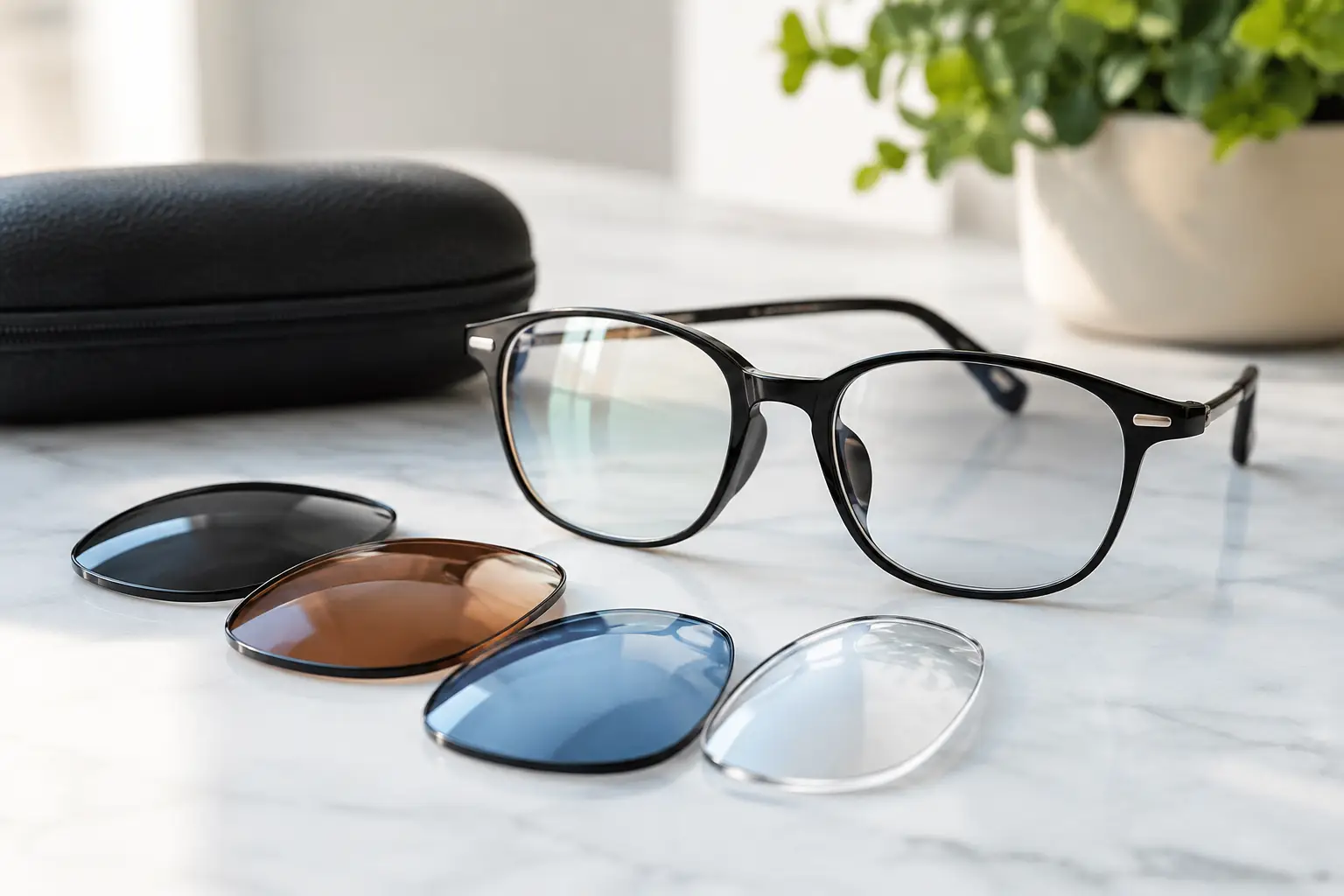
A good guide to specialty lens options should begin somewhere more useful than a list of coatings. Start with the moment your glasses stop keeping up: the late-afternoon screen blur, the glare on a rainy drive, the progressives that feel wrong on stairs, or the sunglasses you leave at home because they do not work with your prescription. Your eyes do not live on an eye chart. Your lenses should be chosen for the places, tasks, and lighting you actually move through.
Specialty lenses are not automatically more complicated or more expensive for the sake of it. They are simply designed to solve a more specific visual problem. The right option can make a noticeable difference in comfort, clarity, and confidence. The wrong one can be technically impressive and still spend most of its life in its case.
Guide to specialty lens options: start with your day
A lens recommendation should account for your prescription, frame choice, how you use your eyes, and how you prefer to wear glasses. A person who spends eight hours between a laptop and a second monitor needs something different from a frequent driver, a parent coaching from the sidelines, or someone who changes between indoor and outdoor settings all day.
This is also why two people with the same prescription may leave with entirely different lenses. Lens design is personal. At XO OPTIX, the conversation is built around your routine, not a scripted upgrade path.
Progressive lenses for more than reading menus
Progressive lenses provide distance, intermediate, and near vision in one pair, without the visible line of a bifocal. They can be an excellent everyday solution when you need to look across a room, check your phone, work at a computer, and read fine print without changing glasses.
The trade-off is that progressive designs have distinct viewing zones. The width of the intermediate area, the size of the reading area, and the amount of peripheral softness vary from one design to another. A premium design may offer more comfortable side vision or a wider workspace, but it still needs to be measured and fitted precisely to the frame and to how it sits on your face.
Frame choice matters here. Very shallow frames can limit the available reading area, while frames that slide down the nose can change where the lens zones land. If you have tried progressives before and disliked them, the issue may have been lens design, measurements, frame fit, or a mismatch between the lens and your daily tasks. It is worth looking at the full picture before deciding they are not for you.
Occupational and digital lenses for close work
If your workday happens within arm’s reach, an occupational lens can be more comfortable than an all-purpose progressive. These lenses prioritize near and intermediate vision, making them well suited to desktop work, multiple monitors, detailed creative tasks, study, and kitchen or workshop projects.
They are not designed for driving or viewing across a large room, so they are often a second pair rather than a replacement for everyday glasses. That limitation is exactly what makes them useful. By dedicating more lens space to your screen and desk distances, they can reduce the need to lift your chin or search for the clearest spot in a general-purpose lens.
“Digital lenses” can mean different things depending on the design. Some optimize the viewing areas used for screens; others include a small near support for people who are beginning to notice close-up fatigue. The right choice depends on your prescription and working distance, not simply the number of hours you spend online.
Specialty lenses for driving, glare, and changing light
Driving places unusual demands on eyewear. You need clear distance vision, useful dashboard vision, reliable contrast, and comfort around reflected light from wet pavement, windshields, and low afternoon sun. The lens that feels fine in an office may not feel as helpful behind the wheel.
Polarized prescription sunglasses are a strong option for many daytime drivers and outdoor enthusiasts because they reduce glare from flat reflective surfaces. They can be particularly appealing for time near water, snow, or pavement. However, polarization can make some digital displays harder to read at certain angles, so it is wise to consider the screens you rely on before making it your only sunglass solution.
Photochromic lenses darken in response to UV exposure and can offer convenient everyday light adaptation. They are useful for people moving frequently between indoors and outdoors, though they may not darken as much inside a vehicle because many windshields filter UV light. If driving glare is your main concern, a dedicated prescription sunglass pair may still be the more dependable choice.
A well-made anti-reflective coating is another practical consideration. It can reduce distracting reflections from the lens surface and improve the cosmetic appearance of the lenses. It is not a cure-all for glare, but it is one of those details that can make everyday glasses feel calmer and clearer.
Light sensitivity and Avulux lens choices
For adults and young people 12 and up who experience light sensitivity associated with episodic migraine, Avulux lenses may be worth discussing alongside their usual migraine care. These lenses are available in different formats, including prescription eyewear and custom clip-ons, allowing the choice to reflect how someone uses glasses throughout the day.
The fitting conversation matters. Some people need an option for screens and indoor lighting, while others are more concerned with bright outdoor environments or want a flexible clip-on for a favorite frame. Avulux lenses are not presented as a cure for migraine, and individual experience varies. The value of an in-person consultation is the chance to compare formats, frame fit, prescription needs, and real-world routine without guesswork.
High and complex prescriptions deserve better planning
A strong prescription does not mean you have to settle for lenses that look or feel heavier than necessary. High-index materials can reduce lens thickness, and aspheric designs can create a flatter lens profile in many prescriptions. These choices can improve appearance and comfort, especially in a carefully selected frame.
But thinner is not always the only goal. Some materials offer better impact resistance, some perform differently with rimless or semi-rimless frames, and certain frame shapes can make a bigger difference than a small change in lens index. A frame that is too wide for your prescription may place your eyes far from the optical center and leave more lens thickness at the edges.
This is where careful frame selection and measurements earn their place. A licensed optician can help balance lens material, lens design, frame shape, weight, durability, and your expectations. Honest advice matters more than selling the highest number on a lens label.
Sports, safety, and water call for purpose-built eyewear
Everyday glasses are rarely the ideal tool for an active day. Prescription sports eyewear is designed around movement, coverage, retention, impact considerations, and the visual demands of the activity. A cyclist may prioritize wind protection and peripheral coverage; a court-sport player may need a secure fit; a child in an active program needs eyewear that stays comfortable and stays put.
Sports lenses also require more planning than a standard pair of glasses. Wraparound frames, for example, may need specialized lens calculations to maintain clear vision across the curved frame. Tint, polarization, and impact-resistant materials should be chosen according to the sport and environment, not added as generic extras.
Custom prescription swimming goggles solve a different problem: seeing clearly in the pool without trying to make standard glasses work near water. They can be made for adults and children and should fit securely without excessive pressure around the eye area. For families managing lessons, swim clubs, or recreational weekends, a dedicated pair can remove one small but persistent frustration.
Custom clip-ons are a refined alternative to a second frame
A custom clip-on can be one of the most practical specialty options, especially when you love your everyday frame. Unlike a generic attachment, a custom clip-on is made to follow the shape of your frame, creating a more intentional look and a more secure fit.
It can be made as a sun clip, a polarized clip, or a specialty light-filtering option. This approach works well for people with complex prescriptions, progressive lenses, or handcrafted frames they do not want to duplicate. It also keeps your primary glasses familiar and properly fitted while adding flexibility when lighting changes.
The trade-off is simple: you need to keep track of a separate piece. For many people, that is a small price for not having to maintain another full prescription frame.
The fitting is part of the lens
Lens choices can sound technical, but the final experience is wonderfully practical. Can you work without craning your neck? Can you read directions while cooking? Can you step outside comfortably? Can you see the road, your dashboard, and the signs ahead? Those are the questions that matter.
Bring your usual routine into the conversation, including your screen setup, driving habits, hobbies, lighting concerns, and the glasses you have loved or avoided wearing. The best specialty lens is not the one with the longest feature list. It is the one that quietly makes your day easier to see.
Leave a Reply