
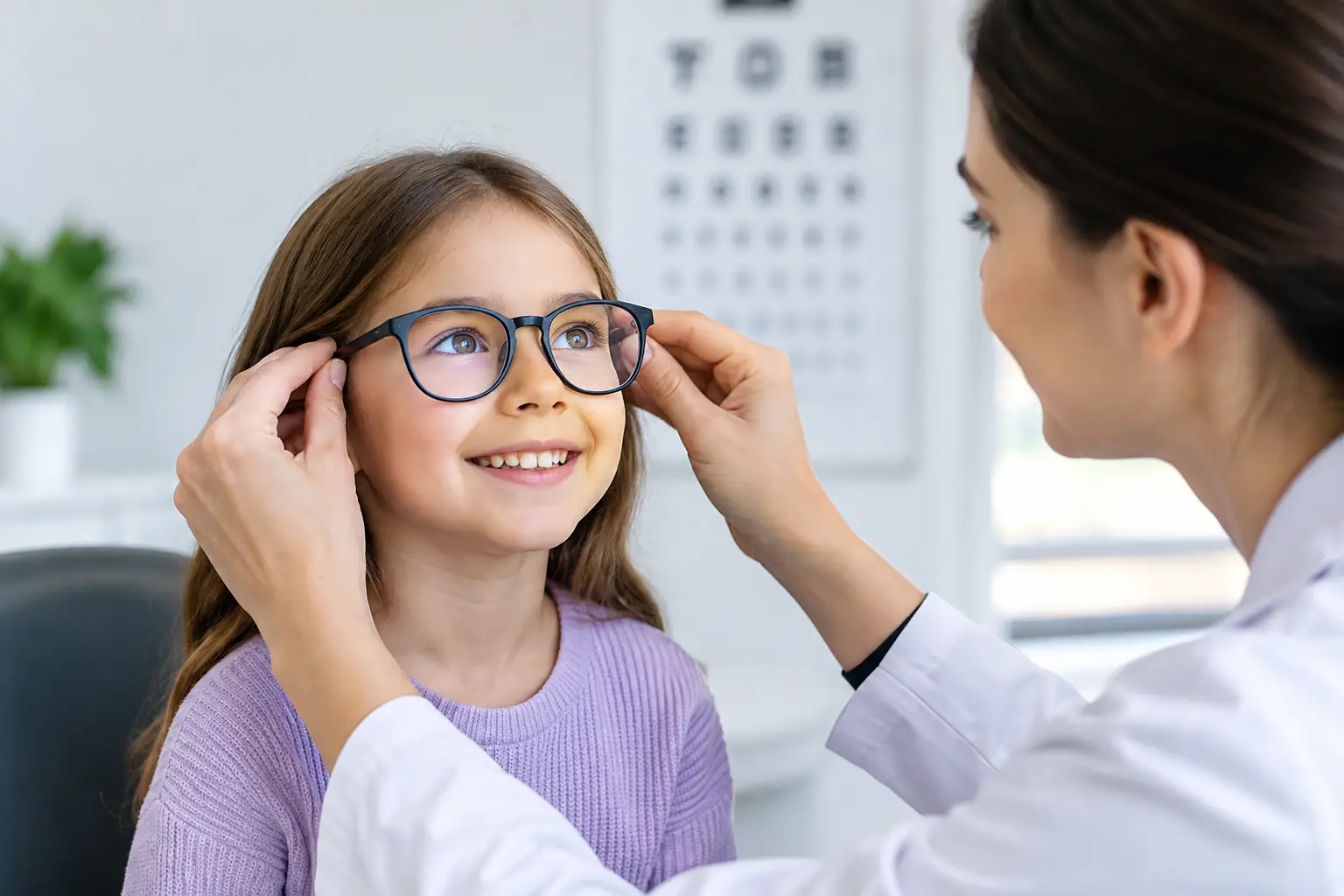
A child who suddenly sits closer to the TV, loses their place on the classroom board, or asks to move nearer at a game is not being dramatic. They may simply be noticing that distance is harder than it used to be. Myopia management gives families a more thoughtful response than updating glasses whenever vision changes. It looks at how a child’s prescription is developing and considers options that may help slow its progression over time.
For parents, that can feel like a lot to take in. The good news is that the first step is not choosing a lens. It is getting clear information, understanding the child in front of you, and making a plan with an eye care professional that fits school, sports, routines, and comfort.
What myopia management is designed to do
Myopia, often called nearsightedness, means close objects tend to look clearer than objects farther away. A child may see a book comfortably but struggle with the whiteboard, street signs, or a ball coming from across the field. Their glasses prescription commonly includes a minus sign.
Standard glasses correct vision, and they remain an essential part of everyday life. Myopia management is a separate conversation about whether specific strategies may help slow the rate at which myopia progresses. The goal is not to promise that a prescription will stop changing or disappear. Children develop differently, and results vary. The aim is to make informed, proactive decisions rather than simply reacting to each stronger prescription.
A comprehensive eye exam with an optometrist is the appropriate place to confirm myopia, review eye health, and determine whether management options are suitable. An optician can then play an important practical role: helping families understand lens formats, fitting eyewear carefully, checking comfort, and making sure the child can actually wear and use what has been recommended.
Why early conversations can matter
Myopia often begins during the school years, when visual demands are changing quickly. Reading, classroom work, tablets, gaming, and outdoor play all compete for a child’s attention. It is tempting to blame one habit, especially screens, but myopia is more complicated than that. Family history, age of onset, visual habits, and individual development can all be part of the picture.
A child who becomes myopic at a younger age may have more years for their prescription to change. That is one reason parents may want to ask about myopia management early, especially if they have noticed repeated prescription increases or if myopia runs in the family. Early does not mean rushed. It means having the conversation while there are options to consider.
The right timing depends on the child and the clinical guidance they receive. Some children may be candidates for a management plan right away. Others may need monitoring first. Honest advice should make room for both possibilities.
The options are not one-size-fits-all
Myopia management can involve specially designed spectacle lenses, contact lens options, and other approaches prescribed and monitored by an optometrist. Each route has its own practical considerations. A solution that works beautifully for one child may be a poor match for another child’s schedule, confidence, or activities.
Specialized spectacle lenses
For many families, glasses are the most familiar starting point. Specialized lenses can be designed with myopia management in mind while still providing clear central vision for daily tasks. They may be especially appealing for younger children, children who are not ready for contacts, or families who prefer a straightforward eyewear routine.
But the frame and fit matter. A lens can only do its job as intended when it is positioned well in front of the eyes. Frames that constantly slide down, pinch behind the ears, or feel too precious to wear at recess are not the right answer. Children need eyewear that feels good enough to become part of life, not something that stays in a case.
Contact lens options
Some children and teens may be suited to contact lenses as part of a care plan established by their optometrist. Contacts can be helpful for active lifestyles, certain sports, or kids who prefer not to wear glasses full time. They also require maturity, careful hygiene, and consistent follow-up.
Age alone does not decide whether contacts are appropriate. A responsible child with supportive parents may be ready earlier than an older child who dislikes routines. The trade-off is simple: contacts can offer freedom, but they ask more of the wearer. Good instruction and a realistic conversation about daily habits are essential.
Everyday habits still belong in the discussion
A management plan is not only about a product. Families can also talk with their eye care professional about visual routines, including regular breaks during concentrated near work and time outdoors. These habits support a more balanced day, but they should not be presented as a replacement for professional care or a guaranteed way to prevent prescription changes.
For a child, the most workable routine is usually the one that does not turn every homework session into a battle. Small, repeatable adjustments tend to be more useful than rigid rules nobody can maintain.
What a good plan looks like at home
Parents often worry that they will miss a warning sign or choose the wrong option. A good myopia management plan should reduce that uncertainty. It gives the family clear expectations for wear, follow-up appointments, and what to do if glasses become uncomfortable, damaged, or no longer seem to provide clear distance vision.
It also accounts for the child’s real day. Does your child play soccer after school? Spend long hours reading? Need to see clearly in a dim gym, on a rainy walk home, or from the back of a music room? Do they resist anything that feels different on their face? Those details are not side notes. Because your eyes do not live on an eye chart.
For glasses wearers, keep the routine simple. Make sure the frames are worn as directed, stored safely, and brought in for adjustments when needed. Children grow, ears and nose bridges change, and a once-perfect fit can gradually become crooked or uncomfortable. A small adjustment can make a large difference in how consistently glasses are worn.
For contact lens wearers, follow the optometrist’s instructions precisely. Do not stretch a replacement schedule, share lenses, or use water to rinse or store them. If wearing becomes uncomfortable or vision changes, the right next step is to contact the prescribing eye care provider rather than trying to troubleshoot at home.
Questions worth bringing to the appointment
The most useful appointments are conversations, not lectures. Parents can ask whether their child’s prescription pattern suggests a myopia management discussion, which options may be appropriate, and how progress will be monitored. It is also reasonable to ask what the day-to-day commitment looks like and what happens if a child cannot adapt to the first choice.
Ask about practical fit as well. Will the child need a separate pair for sports? Is a backup pair sensible for school? How will the frame choice affect lens positioning and comfort? A carefully fitted pair of glasses is not an accessory to the plan. It is part of the plan.
At XO OPTIX, the conversation can extend beyond the prescription itself. Careful frame fitting, child-friendly adjustments, and guidance around lenses help turn a clinical recommendation into eyewear that works for class, play, and everything between.
Give the plan time, then keep asking questions
Parents do not need to become myopia experts overnight. What matters is noticing changes, booking regular professional care, and choosing support that respects both the science and the child’s everyday reality. A thoughtful plan should feel clear, not intimidating.
Your child deserves more than glasses that help them see the board for now. They deserve attentive care that keeps pace with how quickly childhood moves.
Leave a Reply