
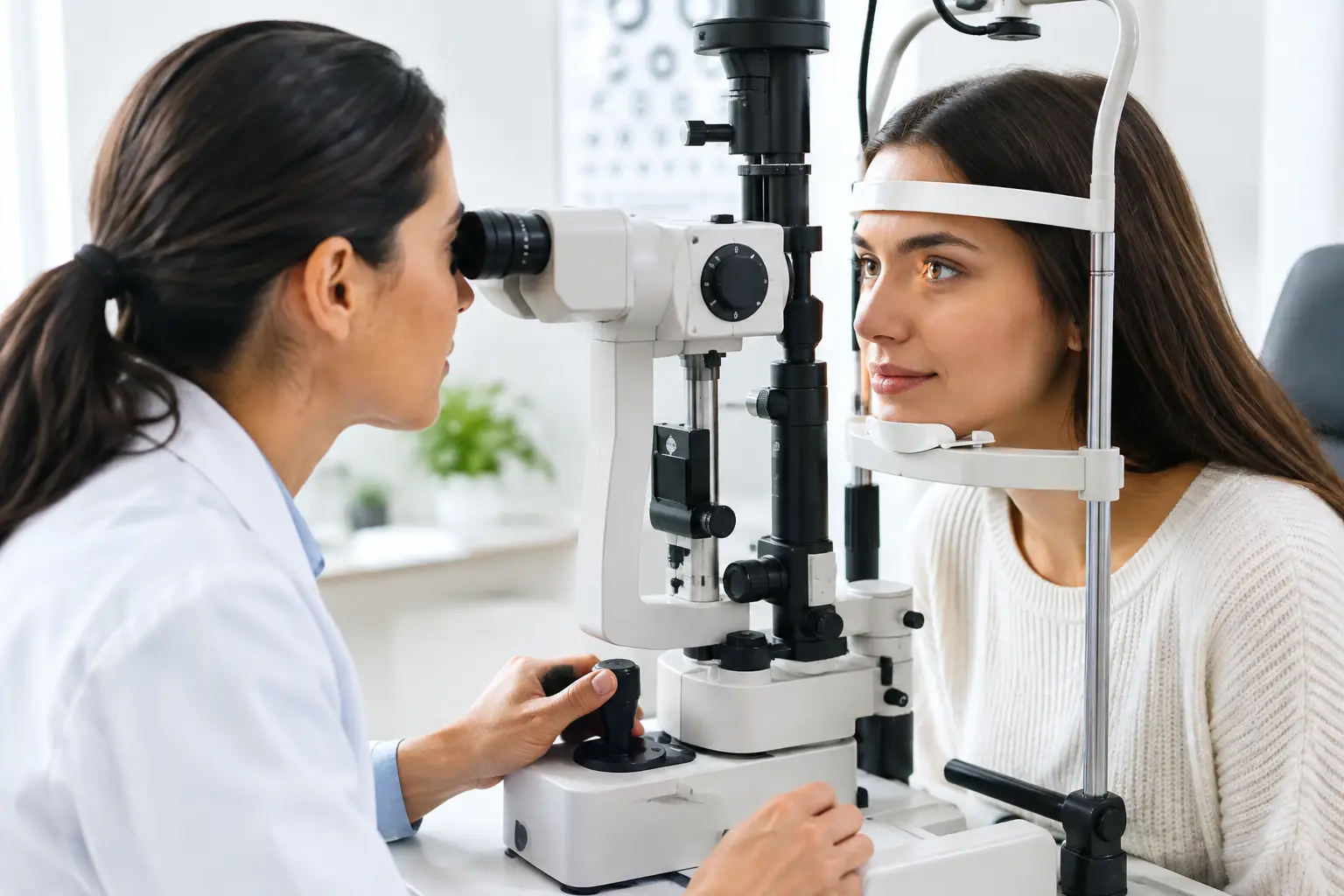
Your eye exam should answer more than one question: “Can you read the smallest line?” It should help explain why your eyes feel tired at 3 p.m., why night driving has become less comfortable, or why your new glasses never quite felt right. Because your eyes do not live on an eye chart. They work through screens, meetings, commutes, workouts, school pickup, and everything else your day asks of them.
A good appointment looks at vision, eye health, and the real-world demands behind your prescription. The goal is not simply stronger lenses. It is clear, comfortable vision that holds up where you need it.
What an eye exam actually checks
A comprehensive eye exam is a health assessment performed by an optometrist or ophthalmologist. It evaluates how clearly you see, how your eyes work together, and whether there are signs of conditions that can affect eye health or vision over time.
The exact testing can vary based on your age, symptoms, health history, and whether your pupils need to be dilated. You may read letters at different distances, compare lens options, have your eye pressure measured, and have the front and back of your eyes examined. Your provider may also assess eye movement, focusing ability, peripheral vision, and color vision when relevant.
This is different from a sight test or prescription check. A sight test focuses on determining the lens correction that helps you see most clearly. That information is essential when making glasses or contact lenses, but it is not a substitute for a comprehensive medical eye health examination.
Both have a place. An eye exam helps protect your eye health and identify changes that deserve attention. A detailed prescription and lifestyle assessment helps turn those findings into eyewear you can genuinely wear all day.
Why “20/20” is not the whole story
You can have 20/20 distance vision and still struggle visually. Many people see clearly across a room but experience headaches, fluctuating focus, dry eyes, glare, or a heavy, tired feeling after hours on a laptop. Others notice trouble only when driving at night, reading fine print, or shifting between a dashboard and the road.
These experiences do not automatically mean you need a stronger prescription. Dry eye, reduced focusing flexibility, eye alignment concerns, lighting, screen habits, and lens design can all play a role. The useful question is not only, “What can you see?” It is, “When does seeing become work?”
That distinction matters for professionals who move between multiple screens, students spending long evenings reading, and parents noticing that a child holds books unusually close. It also matters for people whose prescription has barely changed but whose glasses no longer feel comfortable in daily life.
How often should you schedule an eye exam?
The right schedule depends on your age, risk factors, symptoms, and the guidance of your eye care provider. Many adults benefit from regular comprehensive exams every one to two years, even if their vision seems stable. Children need exams on a schedule recommended by their provider, particularly because visual development and myopia progression can change quickly.
You may need more frequent care if you have diabetes, high blood pressure, glaucoma risk, a history of eye disease, significant dry eye, or medications that can affect vision. Contact lens wearers also need regular evaluations to confirm that their lenses remain safe and appropriate for their eyes.
Do not wait for a routine appointment if you develop sudden vision loss, flashes of light, a sudden shower of floaters, eye pain, marked redness, double vision, or a curtain-like shadow in your vision. Those symptoms need prompt medical attention.
Come prepared with the details that matter
An eye exam is more productive when your provider understands what your eyes do all day. Bring your current glasses and contact lens information, even if you dislike them. Old eyewear can reveal useful clues about a prescription change, wear pattern, or fit issue.
It also helps to mention when problems happen. Is it after video calls? Under bright grocery store lighting? On rainy night drives? When reading a phone in bed? Small details often make the difference between a technically accurate prescription and a practical solution.
Share your health history, medications, family history of eye disease, and any recent changes in headaches, light sensitivity, or visual comfort. If dilation may be part of your visit, consider bringing sunglasses and arranging your day with the possibility of temporary blur or light sensitivity in mind.
After the exam: your prescription needs context
A prescription is a starting point, not a finished pair of glasses. Two people can have the same numbers and need very different lens recommendations. A graphic designer working at close range, a driver commuting after dark, and a golfer tracking a ball against changing light all ask different things of their vision.
This is where a careful optical consultation earns its place. Frame fit affects where lenses sit in front of your eyes. Lens measurements affect how well progressive lenses perform. Material, coatings, and design affect weight, reflections, contrast, scratch resistance, and comfort. None of that is an excuse for an awkward upsell. It is simply the work of matching eyewear to a person instead of treating every prescription like a commodity.
For instance, a basic single-vision lens may be perfectly suitable for someone who uses glasses occasionally. A screen-intensive professional may benefit more from a lens design tailored to near and intermediate distances, depending on their prescription and work setup. Someone with presbyopia may need progressive lenses, but the best design depends on frame choice, reading habits, and how much peripheral awareness they need while moving through the day.
The honest answer is often: it depends. Better lenses are not automatically better for every wearer. The right choice is the one that solves the problem you actually have.
Children, myopia, and early changes
For children, eye care is about more than seeing the whiteboard. A child may not realize their vision is different from anyone else’s, and they may adapt in ways that are easy to miss. Squinting, sitting very close to screens, losing their place while reading, rubbing their eyes, or avoiding detailed work can all be worth mentioning.
Myopia, or nearsightedness, often progresses during childhood. Regular eye exams help track those changes and open a conversation about management options when appropriate. Early attention does not guarantee a particular outcome, but it gives families more information and more time to make thoughtful decisions.
Children also need frames that stay put, lenses that suit their routines, and adjustments as they grow. A pair that looks great but slips during recess is not doing its job.
Make space for ongoing care
Your vision can change gradually enough that you barely notice it. A yearly or regular eye exam creates a useful baseline, while an optical review can address the everyday frustrations that numbers alone do not explain.
At XO OPTIX, the conversation continues after the prescription is written. Careful fitting, adjustments, repairs, and honest lens guidance are part of helping eyewear feel natural, not merely new. Your eyes work hard. Give them care that pays attention to where they are working hardest.
Leave a Reply